
Refractory knee osteoarthritis: 13 international experts agree on a definition and highlight innovative options

Thirteen experts from Europe and the Middle East have agreed on what makes a patient with knee osteoarthritis “refractory”. Their paper has just been published in Therapeutic Advances in Musculoskeletal Disease. Read the open-access paper
Some patients still have knee pain despite well-conducted treatment. Clinicians call them refractory, yet the term had no shared definition. Until now, this gap made it harder to:
- identify these patients;
- make clinical decisions;
- design clinical trials of new treatments;
- compare results across studies.
The International Symposium on Intra-Articular Treatment (ISIAT) convened a panel of 13 experts. It brought together orthopedic surgeons, rheumatologists, sports and rehabilitation physicians, and basic scientists. A systematic literature review identified 3,047 records and included 43 publications. The panel then voted in a two-round Delphi process. In total, 13 of the 15 proposed statements reached consensus.
What the consensus says
The experts propose a shared definition of refractory knee osteoarthritis:
Persistent symptoms (at least 3 to 6 months) and altered quality of life despite optimized, guideline-based multimodal conservative therapy.
According to the consensus, conservative therapy includes:
- patient education, structured exercise and weight management when indicated;
- topical or oral NSAIDs;
- intra-articular injections;
- when appropriate, centrally acting agents that target pain through other mechanisms.
To identify these patients, the panel recommends using the PASS threshold (Patient Acceptable Symptom State).
The panel stresses one point. Refractory osteoarthritis is not simply resistance to a treatment. Several factors combine: the condition of the joint, knee biomechanics, and the way pain develops and is experienced. The panel unanimously recognizes that managing these patients remains an unmet clinical need.
Considering the patient profile from the start
The authors draw a practical conclusion. Treatment should take the patient’s phenotype into account from the outset.
For hyaluronic acid injections, the cited literature associates certain profiles with a poor response: patellofemoral involvement, obesity and Kellgren-Lawrence grade IV.
The consensus algorithm builds these factors into treatment personalization.
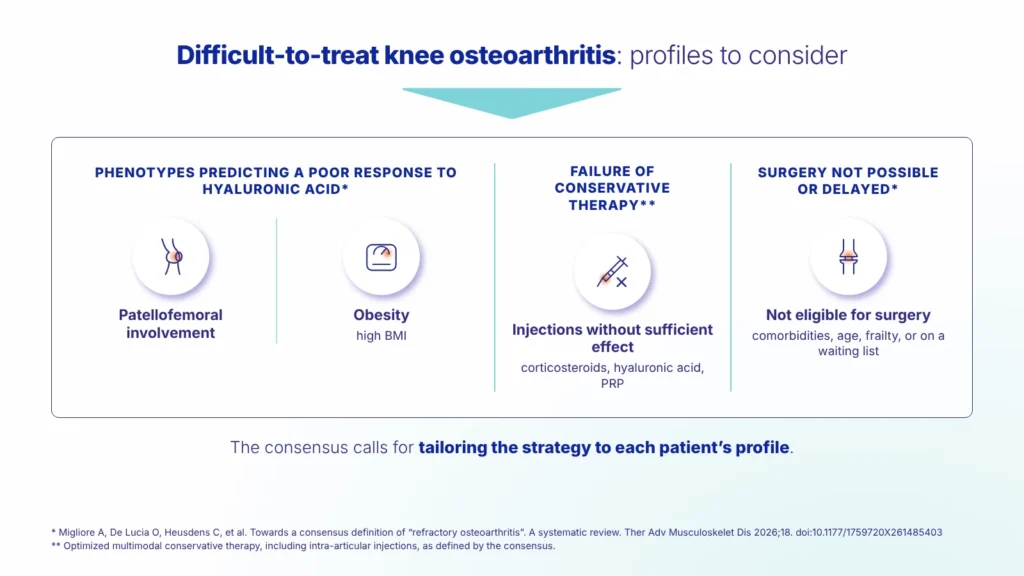
The panel also examined patients who are not eligible for surgery (comorbidities, age, frailty) or who are on a waiting list. The statement that these patients currently have few treatment options narrowly missed consensus, with 84.6% agreement against an 85% threshold.
Innovations cited by the authors
Several novel interventions are being investigated for patients with limited treatment options beyond standard care. Some are already available, while others are still being evaluated. The authors cite three of them. Each relies on a different approach: intra-articular injection, interventional radiology and joint-preserving surgery.
Intra-articular injection
CM-chitosan (carboxymethyl-chitosan)
A biopolymer of fungal origin that lubricates the joint and scavenges free radicals, which are harmful to joint integrity. In patients with refractory knee osteoarthritis, a single injection improved symptoms and function for up to 12 months in the randomized PIONEER trial. A German observational cohort provides complementary long-term data.
Van Overschelde P, et al. Osteoarthritis Cartilage Open 2025 · Lynen NA, et al. Rheumatol Ther 2024. CM-chitosan is developed by KiOmed Pharma.
Interventional radiology
Genicular artery embolization
A minimally invasive outpatient technique. It targets the new blood vessels that form in the osteoarthritic knee. A literature review highlights evidence of effectiveness in patients refractory to conservative management.
Epelboym Y, et al. Skeletal Radiol 2023.
Joint-preserving surgery
Knee joint distraction
A recent case series suggests symptom relief in young patients after failed conservative treatment. It also reports a significant increase in joint space, possibly linked to cartilage regeneration.
Vandenrijt J, et al. J Exp Orthop 2025.
The panel
Prof. Alberto Migliore (scientific coordinator, San Pietro Fatebenefratelli Hospital, Rome), Dr. Orazio De Lucia (ASST Gaetano Pini-CTO, Milan), Prof. Christiaan Heusdens (University of Antwerp, Antwerp University Hospital), Dr. Abdulla Alrahoomi (Sheikh Tahnoun Bin Mohammed Medical City, Al Ain), Prof. Francesco Benazzo (Fondazione Poliambulanza, Brescia), Prof. Xavier Chevalier (Paris-Est Créteil University), Prof. Demirhan Diracoglu (Istanbul University), Dr. Marek Krochmalski (Medical Magnus Clinic, Łódź), Dr. Bernard Maillet (Polyclinique Saint-Odilon, Moulins), Prof. Thomas Neri (Hospices Civils de Lyon), Dr. José Luis Rodrigo (Dr. Peset University Hospital, Valencia), Prof. Oliver Tobolski (Ortho4Sport, Cologne) and Prof. Yves Henrotin (mSKIL, University of Liège). Steering committee: Dr. De Lucia, Prof. Chevalier, Prof. Henrotin, Prof. Heusdens and Prof. Neri. The publication was supported by an unconditional educational grant from KiOmed Pharma.
Learn more about CM-chitosankiomedine-one.be
Frequently asked questions
What is refractory knee osteoarthritis?
According to the international consensus published in 2026, it is defined as persistent symptoms (at least 3 to 6 months) and altered quality of life despite optimized, guideline-based multimodal conservative therapy.
What does conservative therapy include?
Patient education, structured exercise and weight management when indicated. These are combined with individualized treatments: topical or oral NSAIDs, intra-articular injections and, when appropriate, centrally acting agents that target pain through other mechanisms.
Is a refractory patient simply resistant to treatment?
No. According to the consensus, several factors combine: the condition of the joint, knee biomechanics, and the way pain develops and is experienced.
Should the patient profile only be considered at an advanced stage?
No. The consensus recommends taking the patient profile into account from the start of treatment. According to the cited literature, patellofemoral involvement, obesity and Kellgren-Lawrence grade IV are associated with a poor response to hyaluronic acid.
Which innovations do the authors cite for refractory osteoarthritis?
Three recent interventions, at different stages of development, for patients with limited options: intra-articular CM-chitosan injection (randomized PIONEER trial and German cohort), genicular artery embolization (literature review) and knee joint distraction in young patients (case series).
Reference: Migliore A, De Lucia O, Heusdens C, et al. Towards a consensus definition of “refractory osteoarthritis”. A systematic review. Ther Adv Musculoskelet Dis 2026;18:1-10. doi.org/10.1177/1759720X261485403
